

Breaking Down the Concept of Small Mobile Crushers and Their Hourly Capacity
A small mobile crusher is a compact, portable machine designed for on-site crushing of materials like rocks, concrete, asphalt, and aggregates. Unlike larger stationary crushers, these units are mounted on tracks or wheels, allowing easy transportation and setup at various job sites, such as construction zones, quarries, or recycling facilities. The “small” designation typically refers to models with lower power requirements and smaller feed openings, making them ideal for limited spaces or smaller-scale operations.
Key components include a jaw, impact, or cone crusher mechanism, a hopper for feeding materials, conveyor belts for output, and often screens for sorting crushed products. The hourly crushing capacity—measured in tons per hour (TPH)—varies based on the machine’s design, but for small models, it generally ranges from 10 to 90 TPH. This capacity depends on factors like the type of material being crushed (e.g., soft limestone vs. hard granite), input size, moisture content, and operational efficiency. For instance, entry-level small mobile jaw crushers might handle 10-30 TPH for softer materials, while more robust compact units can reach up to 90 TPH for concrete recycling. Understanding this breakdown helps operators select the right equipment to match project demands without over- or under-investing.
Related Questions and Answers
1. What factors influence the crushing capacity of a small mobile crusher?
Several variables affect how many tons a small mobile crusher can process per hour. Material hardness and density play a major role—softer materials like concrete allow for higher throughput, while denser rocks like granite reduce it. Input size must fit the crusher’s feed opening; oversized pieces require pre-breaking, slowing production. Operational settings, such as crusher speed, closed-side setting (for jaw crushers), and maintenance levels, also impact efficiency. Environmental factors like moisture can cause clogging, dropping capacity by 10-20%. Additionally, the crusher type (jaw vs. impact) and engine power determine baseline TPH, with estimates calculated using formulas like volume per swing times density times cycles per minute.
2. How does a small mobile crusher compare to a larger stationary one in terms of capacity and use?
Small mobile crushers prioritize portability over raw power, offering 10-90 TPH compared to stationary units that can exceed 500 TPH for high-volume quarries. They excel in flexible, on-site applications like urban demolition or remote sites where transporting materials is costly. Stationary crushers are fixed installations for continuous, large-scale production but require significant setup time and infrastructure. Mobiles reduce haulage needs and emissions by processing materials directly at the source, though they may need more frequent relocation for bigger projects.
Benefits of Using Small Mobile Crushers
Small mobile crushers offer several advantages that make them a smart choice for contractors and small operations. First, their mobility allows for quick relocation between sites, reducing downtime and transportation costs for raw materials—potentially saving up to 30% on logistics by crushing on-site. This flexibility supports sustainability by minimizing fuel use and carbon emissions from hauling. Second, they lower overall operating expenses through easier permitting, faster setup (often under an hour), and reduced need for large crews or heavy infrastructure. Third, they enhance productivity in confined spaces, turning waste into reusable aggregates, which can create new revenue streams from recycling. Finally, their compact size ensures high-quality output with consistent sizing, improving material value while maintaining safety and efficiency in diverse applications like road construction or landscaping.
Step-by-Step Guide: How to Determine and Achieve Hourly Crushing Capacity
To figure out and optimize how many tons a small mobile crusher can crush per hour, follow these detailed steps. This process involves setup, operation, and calculation, ensuring safe and efficient performance. Use the provided operation diagrams for visual guidance.
- Site Preparation and Crusher Positioning: Select a stable, level area free of hazards. Tow or drive the mobile crusher to the site, then deploy stabilizers or tracks for stability. Ensure the machine is aligned with the material pile for easy feeding. Check fuel, oil, and hydraulic levels before starting the engine.

(Diagram showing mobile crusher setup on-site, illustrating positioning and stabilization.)
- Material Assessment and Feeding Setup: Evaluate the input material for size, type, and moisture. Pre-screen if needed to remove oversized pieces. Set up the hopper and feeder; adjust the feed rate to match the crusher’s capacity (e.g., avoid overloading a 50 TPH unit). Start the conveyor belts and ensure safety guards are in place.
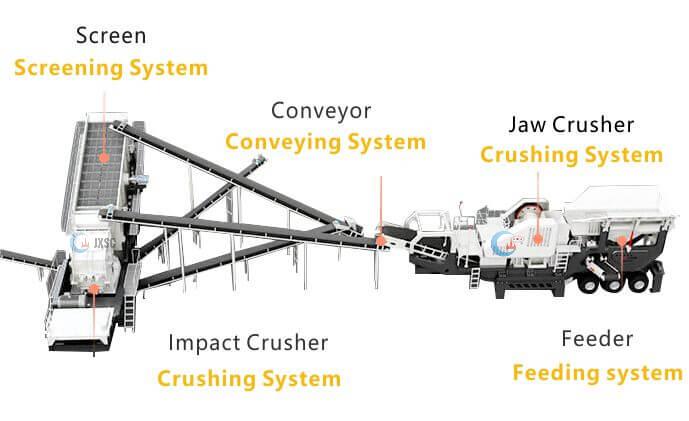
(Operation diagram depicting material flow from hopper to crusher chamber.)
- Crusher Configuration and Startup: Adjust settings like jaw gap or impact rotor speed based on desired output size. Power on the machine, allowing it to idle for warm-up. Gradually introduce material while monitoring for blockages. Use the control panel to fine-tune speed and pressure.
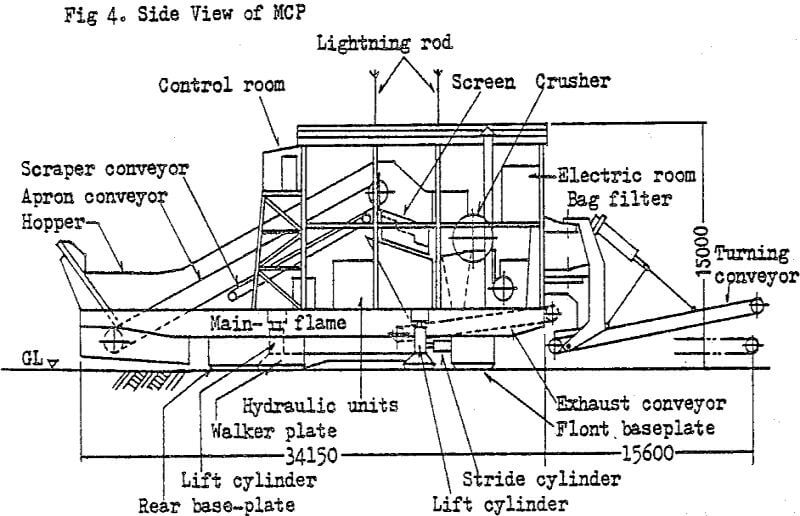
(Side-view diagram of internal crushing components during operation.)
- Monitoring and Capacity Calculation: Run the crusher for a test period (e.g., 30 minutes). Weigh the output using scales or estimate via conveyor volume. Calculate TPH with the formula: (Output weight in tons) × (60 minutes / test duration in minutes). Factors like density (use 1.6 tons/m³ for average rock) and efficiency (aim for 80-90% utilization) refine this. Adjust operations if below target, such as clearing jams or optimizing feed.
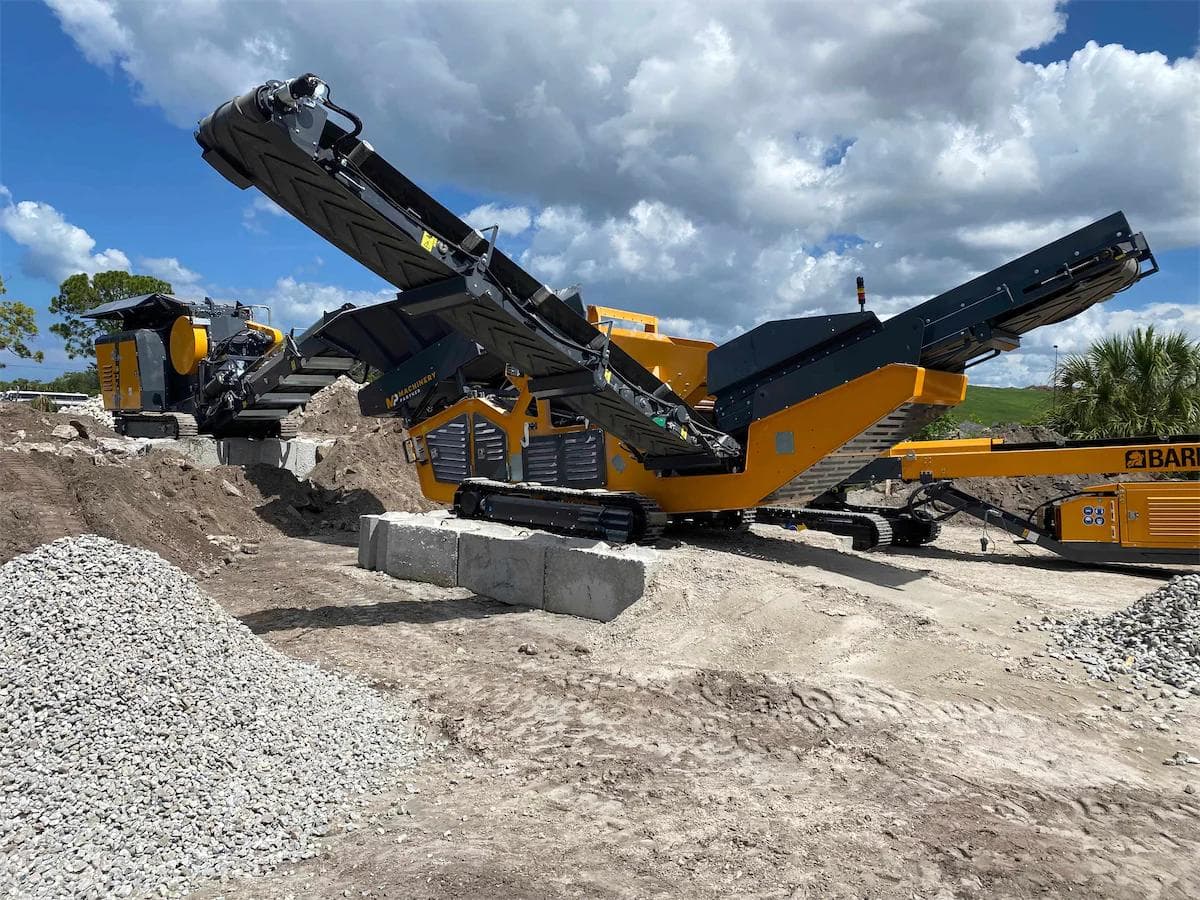
(Step-by-step layout of crusher plant setup, including monitoring points.)
- Shutdown and Maintenance: After operation, stop feeding material and let the crusher clear out. Power down, clean debris, and inspect wear parts. Log the session’s TPH for future reference.
Practical Results from Real-World Applications
Here are 2-3 examples of small mobile crushers in action, demonstrating achievable hourly outputs:
- Concrete Recycling Project: A compact jaw crusher like the Senya 3 model processed urban demolition waste at a rate of 20-30 TPH. Over an 8-hour day, it produced 200 tons of reusable aggregate, reducing landfill needs and generating revenue from sales.
- Quarry Operation for Aggregates: In a small-scale quarry, a mobile impact crusher handled limestone, averaging 50 TPH. This allowed for on-site production of road base material, cutting transport costs by 25% and completing a 400-ton job in one shift.
- Asphalt Demolition Site: A tire-mounted mobile crusher outputted 150 TPH of mixed asphalt and concrete, though scaled for smaller models it adjusted to 80 TPH for finer control. The result was efficient recycling for a highway repair project, with minimal downtime.


