
69 Jaw Crusher with What Size Motor? What Size Secondary Jaw Crusher? What Size Impact Crusher?
The 69 jaw crusher, often designated as the PE600x900 model, is a robust primary crushing equipment widely used in mining, quarrying, and construction industries. It features a feed opening of 600mm by 900mm, designed to handle hard rocks and ores by compressing them between a fixed and movable jaw plate. The motor is the powerhouse that drives the eccentric shaft, enabling the jaw’s toggling motion for crushing. A secondary jaw crusher, typically smaller like the PE250x400 or PE400x600, follows the primary unit to further reduce particle sizes for finer processing. An impact crusher, such as the PF series, uses high-speed rotors and impact plates to shatter materials through kinetic energy, often serving as a tertiary stage for producing cubical aggregates.
One common question is: What factors influence the motor size for a 69 jaw crusher? The answer lies in the crusher’s power requirements, which depend on material hardness, feed size, and desired output capacity—typically ranging from 55kW to 75kW to ensure optimal performance without overload. Another frequent query: How does the size of the secondary jaw crusher affect overall efficiency? It must be matched to handle the output from the primary crusher, usually 1/3 to 1/2 the size, to prevent bottlenecks and maintain a smooth flow in the production line.
Properly configuring a 69 jaw crusher with the right motor, secondary jaw crusher, and impact crusher offers several advantages. It enhances energy efficiency by avoiding underpowered or oversized components that waste electricity. Equipment longevity improves as matched sizes reduce wear and tear on parts like belts and bearings. Production output increases with seamless material flow, minimizing downtime and boosting throughput by up to 20-30% in optimized setups. Safety is also elevated, as balanced configurations prevent vibrations or imbalances that could lead to accidents.
To configure this setup effectively, follow these detailed steps. First, evaluate your raw material properties, including hardness, size, and required final product specifications, along with target hourly capacity (e.g., 50-100 tons for a standard 69 jaw crusher). Use a production line flowchart to map out the process. As illustrated in the flowchart below, which outlines the sequence from primary to tertiary crushing:

Next, select the motor for the 69 jaw crusher based on power calculations—commonly 55-75kW for standard operations. Install it by aligning the motor base with the crusher frame, securing with bolts, and connecting via V-belts to the flywheel. Refer to the installation guide shown here for precise alignment to avoid belt slippage:

Then, determine the secondary jaw crusher size by matching it to the primary output; for a 69 model producing mid-sized aggregates, opt for a PE400x600 (feed opening 400x600mm) to handle 15-60 tons per hour. Consult a sizing chart to verify compatibility, as depicted in this reference chart for secondary crushers:

Finally, choose the impact crusher based on the secondary output and desired fineness; a PF1010 (rotor diameter 1000x1050mm) pairs well, processing up to 80 tons per hour. Integrate it by ensuring conveyor belts feed material evenly, and check the structural diagram for proper matching:
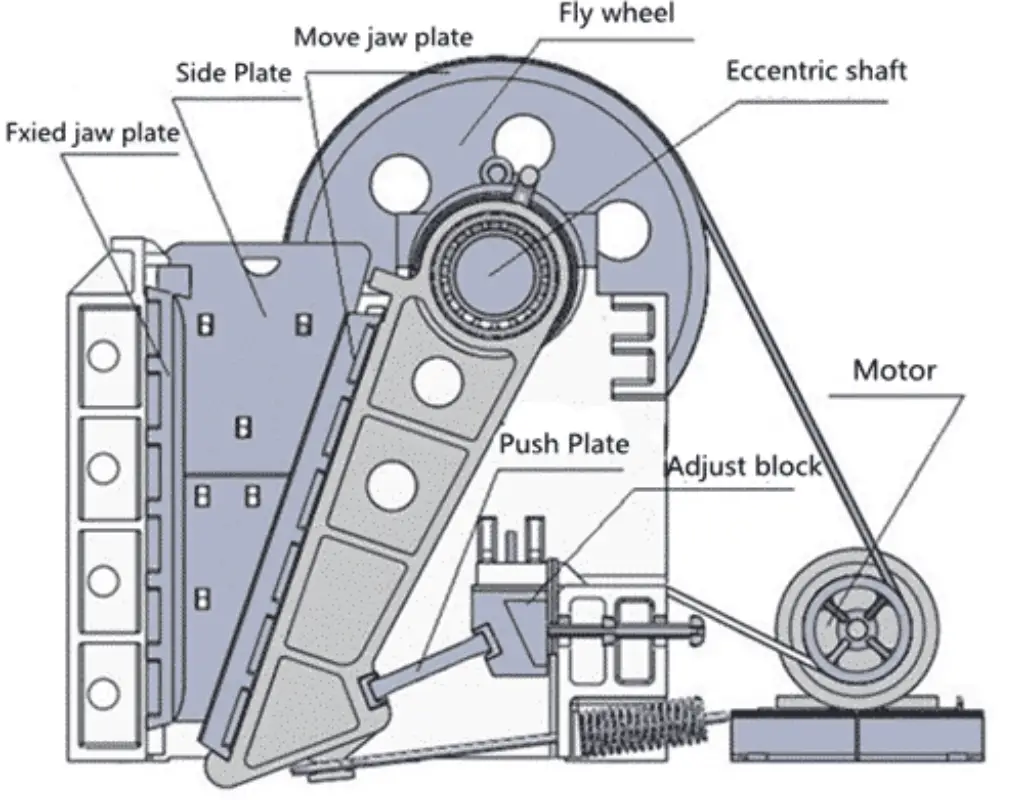
In practice, a quarry in China equipped a PE600x900 with a 75kW motor, a PE400x600 secondary, and a PF1010 impact crusher, achieving 120 tons per hour of gravel with 15% less energy use than mismatched setups. Another site in the US used a 55kW motor for lighter limestone, paired with a smaller PE250x400 secondary and PF1007 impact, resulting in consistent 80-ton output and reduced maintenance costs by 25% over six months. A third example from a construction project involved upgrading to a 75kW motor and PF1210 impact, boosting efficiency to 150 tons per hour while extending belt life by 40%.


